Treasury secretary says ‘we will see’ about $2,000 rebate checks to Americans as Supreme Court weighs Trump’s tariffs
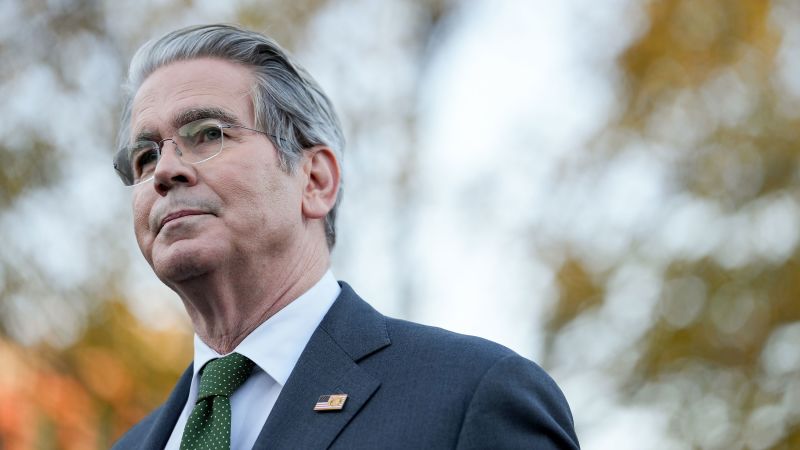
Treasury Secretary Scott Bessent has underscored that President Donald Trump’s proposed $2,000 tariff rebate checks for most Americans would necessitate congressional approval, highlighting a significant hurdle to the plan’s implementation. Speaking on “Sunday Morning Futures,” Bessent stated, “We will see. We need legislation for that,” indicating that while the checks “could go out,” their distribution hinges on legislative action.
Trump has, in recent months, frequently championed the idea of leveraging tariffs to finance these direct payments, most recently reiterating this in a post on Truth Social. He asserted that opponents of tariffs are “FOOLS!” and promised “A dividend of at least $2000 a person (not including high income people!) will be paid to everyone.” The concept of distributing a portion of tariff revenue to Americans was first introduced in July.
Bessent elaborated that these payments would be designated for “working families” and would be subject to an income limitation. This domestic-facing aspect of tariff policy is juxtaposed against ongoing international trade dialogues and regulatory challenges.
Supreme Court’s Shadow Looms Over Tariff Landscape
Adding a layer of uncertainty to the administration’s tariff strategy is the impending Supreme Court decision on the president’s use of an emergency law, which could invalidate a substantial portion of existing tariffs. During oral arguments earlier this month, the court expressed considerable concern regarding the administration’s reliance on this particular statute, with several conservative justices questioning the government’s position.
The tariffs themselves have faced criticism for their role in exacerbating inflation on consumer goods. However, Bessent and other economic advisors within the Trump administration have consistently refuted the notion that tariffs function as a direct tax on American consumers. Bessent, when asked about the potential implications of an unfavorable Supreme Court ruling, posed critical questions: “I don’t think this ruling is going to go against us, but if it does, what’s (the Supreme Court’s) plan for refunds? Because how is this going to get to consumers? Are they just going to hand some of these importers big windfalls?” He concluded, “I don’t think the Supreme Court wants to wade into a mess like that.”
Navigating the Complexities of Rare-Earth Minerals and Trade
In parallel to domestic tariff discussions, the United States has yet to finalize a trade agreement with China concerning rare-earth minerals. These minerals are critical components in the manufacturing of both consumer electronics and vital military equipment, making the lack of a definitive trade deal a significant concern amidst ongoing trade tensions between the two economic giants.
Bessent expressed optimism, stating that a deal “will hopefully” be reached by Thanksgiving. This follows a framework agreement announced in October that successfully averted the threat of additional 100% tariffs on Chinese goods. The caveat for this averted escalation was Beijing’s commitment to discontinue current and proposed export controls on crucial rare earths. Bessent indicated that the agreement would permit rare earths to “flow freely as they did before April 4,” the date marking the commencement of the trade war initiated by Trump’s reciprocal tariffs.
“The prices for those goods weren’t necessarily going up just because of tariffs. The prices will go down, of course … because the supply of goods into the US is going to increase.”
Economic Outlook: From Shutdown Setbacks to Accelerated Incomes
The recent conclusion of the longest government shutdown in U.S. history, which ended on Wednesday after Congress passed a spending package, has had an impact on economic progress. “Of course the government shutdown set us back,” Bessent acknowledged on Sunday.
While Bessent did not offer a projection for fourth-quarter Gross Domestic Product (GDP), he expressed confidence in a more optimistic outlook for the early months of 2026. According to his forecast, inflation is expected to decrease, and real income growth is poised to “substantially accelerate” during the first two quarters of the year. “When those two lines cross, Americans are going to feel it,” he remarked, suggesting a tangible positive effect on household finances.
Tariff Exemptions Aim to Ease Grocery Price Pressures
In a move aimed at directly addressing rising grocery costs, the Trump administration announced on Friday that numerous agricultural imports would be granted exemptions from “reciprocal” tariffs. These exemptions offer relief from rates that could have reached as high as 50% on imports from Brazil, or the lower 10% duty applied to many other nations. This strategic adjustment seeks to mitigate the impact of tariffs on essential food items.
The struggle with elevated grocery prices is a tangible concern for consumers. Average grocery prices in the U.S. were 2.7% higher in September compared to the previous year. Specific items have seen even steeper increases, with coffee prices, for example, rising nearly 21% year-over-year in August. Bananas were also more expensive, costing approximately 6.6% more in August than a year prior, according to [U.S. Bureau of Labor Statistics](https://www.bls.gov/regions/midwest/news-release/consumerprices_chicago.htm) data.
National Economic Council Director Kevin Hassett elaborated on the expected impact of these tariff exemptions, telling ABC’s “This Week” on Sunday, “The prices for those goods weren’t necessarily going up just because of tariffs. The prices will go down, of course … because the supply of goods into the US is going to increase.”
These economic pressures are reflected in consumer sentiment. The consumer sentiment index, a key indicator of household economic outlook, fell to 50.3 in November from 53.6 in October, according to the University of Michigan. This decline presents a sobering backdrop as the nation heads into the crucial holiday shopping season, amplifying the importance of measures designed to stabilize and reduce consumer costs.