Set to make Tigers nation’s ‘best,’ Kiffin introduced at LSU
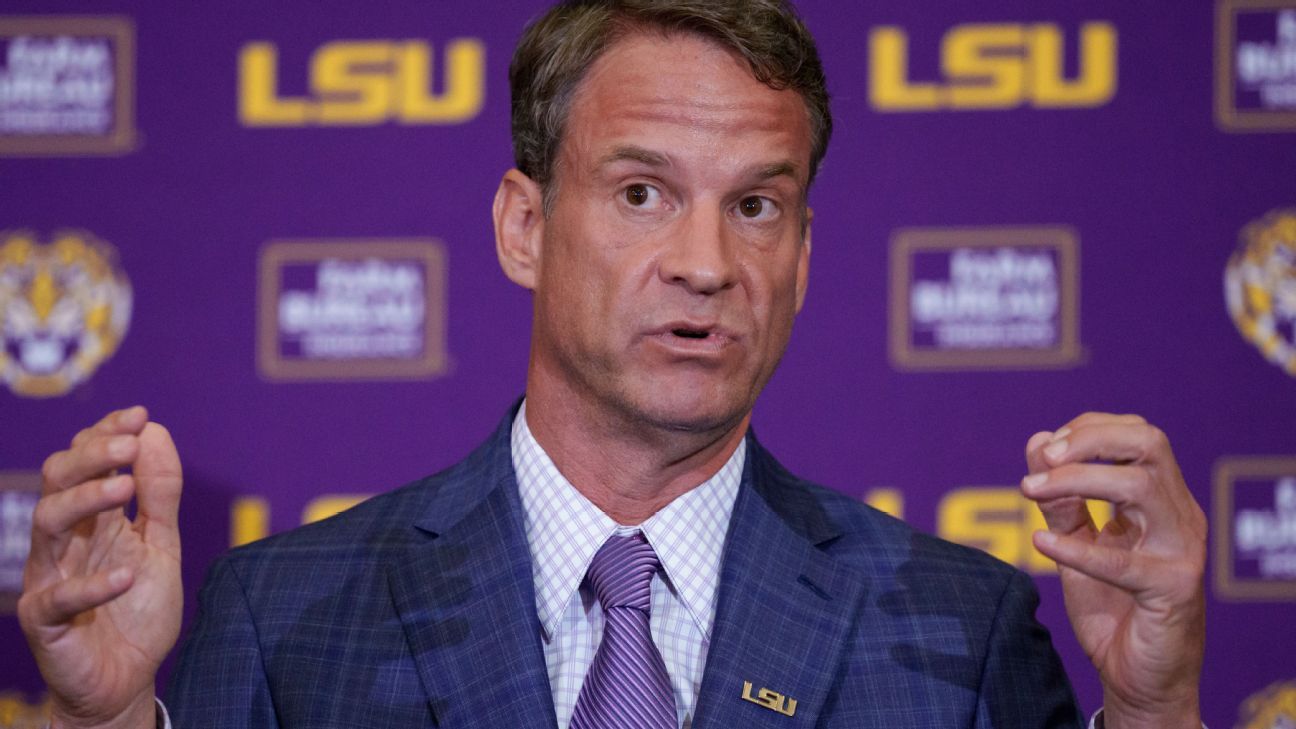
Kiffin Takes the Helm at LSU, Leaving Ole Miss in Playoff Limbo
BATON ROUGE, La. – Lane Kiffin, a coach known as much for his offensive prowess as his dramatic career moves, officially became the head football coach at Louisiana State University on Monday, promising to restore the program to national dominance. His arrival concludes a whirlwind coaching search for the Tigers and leaves Ole Miss scrambling to navigate the College Football Playoff without the architect of their historic season.
The move, finalized after weeks of speculation linking Kiffin to both LSU and the University of Florida, culminates a pattern of high-profile departures that have become a hallmark of his 14-year head coaching career. Kiffin’s record stands at 117-53 across tenures at Tennessee, USC, Florida Atlantic, and Ole Miss, demonstrating a consistent ability to build winning programs – and, seemingly, to orchestrate equally memorable exits.
A Painful Farewell to Oxford
Kiffin didn’t shy away from acknowledging the difficult nature of leaving Ole Miss, which finished the regular season with an impressive 11-1 record and a No. 7 ranking in the College Football Playoff. “The last 48 hours, in a lot of ways, sucked,” he admitted during Monday’s introductory press conference. He detailed informing Ole Miss athletic director Keith Carter of his decision on Saturday night and a subsequent attempt to negotiate continuing to coach the Rebels through their playoff game – a request ultimately denied.
Carter, Kiffin explained, felt obligated to prioritize the long-term stability of the program, recognizing that his departure would inevitably create disruption. “He told me that though it might make sense to everybody outside the program to keep the staff together for the playoff, Carter has to live in Oxford after I’m gone,” Kiffin recounted. The decision sparked outrage among Ole Miss fans, some of whom confronted Kiffin at the airport as he departed for Baton Rouge.
LSU’s Aggressive Pursuit and the Changing Landscape of College Coaching
LSU athletic director Verge Ausberry defended the university’s aggressive pursuit of Kiffin, emphasizing the need to protect the program’s interests in a rapidly evolving college football landscape. “There’s no rule in college football, like in the NFL, that prohibits schools from contacting coaches until the season is over,” Ausberry stated. “That’s not our fault. It was a hand we were dealt, and I had to protect LSU’s interests.”
The situation highlights a growing trend in college football where coaching searches are conducted with increasing frequency and boldness, even during the season. This practice, fueled by the lucrative nature of major college football programs and the constant pressure to compete for championships, has created a climate of uncertainty and instability. According to data from the National Collegiate Athletic Association (NCAA), the average salary for a Football Bowl Subdivision (FBS) head coach has increased by 68% since 2010, reaching $3.4 million in 2023, demonstrating the financial stakes involved in these high-profile hires.
A Familiar Stage, A New Challenge
Kiffin’s arrival at LSU feels, in some ways, like a homecoming. He has coached against the Tigers numerous times throughout his career and expressed a palpable excitement about the program’s potential. “I called one person. I called Ed Orgeron,” Kiffin revealed, referencing the former LSU coach who led the team to a national championship in 2019. “I said, ‘Hey, man, all I can do… this place just makes me want to talk like you right now.’”
The new LSU coach also acknowledged a conversation with Louisiana Governor Jeff Landry, who played a prominent role in the coaching search following the departure of former athletic director Scott Woodward. Kiffin described the call as “unique,” adding, “I could feel his passion and energy in that call for the state of Louisiana and for LSU football.”
Looking Ahead: Recruiting, NIL, and Championship Expectations
Kiffin’s immediate focus is on finalizing LSU’s recruiting class ahead of the early signing period, which runs from Wednesday to Friday. He confirmed that Frank Wilson will serve as the interim head coach for the Tigers’ upcoming bowl game, but remained tight-lipped about potential staff changes. He also emphasized the importance of leveraging Name, Image, and Likeness (NIL) opportunities to attract and retain top talent.
Kiffin agreed to a seven-year contract with LSU worth $13 million annually, including performance-based bonuses tied to College Football Playoff participation and a national championship. Interestingly, Kiffin admitted he doesn’t even bother asking his agent, Jimmy Sexton, about the details of his contracts, preferring to focus on building a winning program.
“When you take the history, tradition, passion and the great players in the state of Louisiana, no one can argue that when you’re in Tiger Stadium on Saturday night, there is nothing like it,” Kiffin concluded. “This place is built for championships with championship expectations — we understand that — but as an elite competitor, that’s exactly what you want, and that’s why we’re here.”
ARTICOL ORIGINAL:
BATON ROUGE, La. — Lane Kiffin was introduced as LSU‘s coach Monday, promising to restore it to “the best program in all of college football,” while detailing what he said was an excruciating decision to leave Ole Miss.
Kiffin’s arrival ended a monthslong saga in which he was the subject of coaching searches by Florida and LSU while Ole Miss tried to retain him. He leaves Oxford amid a historic season in which the Rebels are 11-1 and No. 7 in the College Football Playoff rankings.
Kiffin said the “last 48 hours, in a lot of ways, sucked,” adding that he understood the passion of furious Ole Miss fans who were at the airport as he departed. He said he informed Ole Miss administrators Saturday night that he was taking the LSU job, and continued a conversation through Sunday trying to figure out how he could continue to coach the Rebels in what he called the “most historic sporting event in the history of the state of Mississippi, a home playoff game.
“There was no way to possibly do it, in my opinion, any better than we did from a timing standpoint,” Kiffin said.
Eventually, Ole Miss athletic director Keith Carter decided that Kiffin would not coach the Rebels, a decision Kiffin said he respected. He said Carter told him that though it might make sense to everybody outside the program to keep the staff together for the playoff, Carter has to live in Oxford after Kiffin is gone.
LSU athletic director Verge Ausberry called Kiffin “a big enough personality to operate in a state of big personalities,” and said LSU had no issues with Kiffin continuing to coach Ole Miss. But, Ausberry said, there’s no rule in college football, like in the NFL, that prohibits schools from contacting coaches until the season is over.
“That’s not our fault,” Ausberry said. “It was a hand we were dealt, and we had to deal with it, and I had to protect LSU’s interests. I have great friends at all those other institutions in the SEC, but this is about doing what’s right for LSU.”
So, Kiffin departed Oxford immediately for Baton Rouge. He arrived, drove by Tiger Stadium, a place where he had coached many times, with the lights on and said he felt “the power of the place.”
“I called one person. I called Ed Orgeron,” Kiffin said of his longtime friend and colleague who won a national title as LSU’s coach in 2019. “I said, ‘Hey, man, all I can do … this place just makes me want to talk like you right now.'”
Kiffin’s first 24 hours included a phone call with Louisiana Gov. Jeff Landry, who took a front-and-center approach in LSU’s coaching situation, which led to the departure of former athletic director Scott Woodward. Kiffin said, with a smile, that the call was “unique” and added, “I could feel his passion and energy in that call for the state of Louisiana and for LSU football.”
Kiffin has a 117-53 record in 14 years as a college head coach at Tennessee, USC, Florida Atlantic and Ole Miss, including seven seasons with at least 10 wins. He also has been a part of five of the most memorable exits in football history: Al Davis detailing his shortcomings as Raiders coach on an overhead projector in Oakland, leaving after one year at Tennessee for the USC job, then being fired from USC at the airport in Los Angeles, followed by Nick Saban dismissing him a week before a national championship game at Alabama, and now leaving Ole Miss for Baton Rouge before the playoff.
He said he did not get emotional by the reaction of fans, which, he said, included some who tried to run him off the road while driving with his son Knox, adding that’s life in the SEC.
“I think that people get really upset when you leave somewhere because they feel hurt because you’re doing a really good job,” Kiffin said. “They ain’t going to the airport and driving from all over to say those things and yell those things and try to run you off the road if you were doing bad.”
Kiffin credited his three biggest mentors, all of whom he considered among the greatest defensive minds in football: his father, Monte Kiffin, Pete Carroll and Saban. Kiffin credited Carroll, who he said promised his late father he’d look after Lane, for encouraging him to take the LSU job. Kiffin hinted that Saban also nudged him.
“Coach Saban coached at another place in this conference, so I can’t really say exactly what he said,” Kiffin said, to laughs from the crowd, about the former Alabama coach. “But I’ll say, I think the world of Coach Saban, and I respect him. And so there’s a reason we’re here.”
Kiffin said his first task was wrapping up the Tigers’ recruiting class, with the early signing period going from Wednesday to Friday. Kiffin said Frank Wilson would continue to serve as the interim head coach for LSU’s impending bowl game but did not provide further clarity on staff positions.
Kiffin agreed to a seven-year contract with LSU on Sunday that will pay him $13 million annually, including a provision that affords him the same CFP bonus structure from LSU that he would have received at Ole Miss, including $150,000 for participating in a first-round CFP game, up to $250,000 for a quarterfinal appearance and another $1 million if he wins the national championship.
He said Monday that he was not aware of his contract terms, adding that he never asks his agent, Jimmy Sexton. Kiffin said he was more concerned about the financial resources to build the program, including NIL for players. He said the plan he heard from LSU proved that this was the best job in football.
“When you take the history, tradition, passion and the great players in the state of Louisiana, no one can argue that when you’re in Tiger Stadium on Saturday night, there is nothing like it,” Kiffin said. “This place is built for championships with championship expectations — we understand that — but as an elite competitor, that’s exactly what you want, and that’s why we’re here.”