Crown Jewels Vandalised: Activists Protest “Tax the Rich”
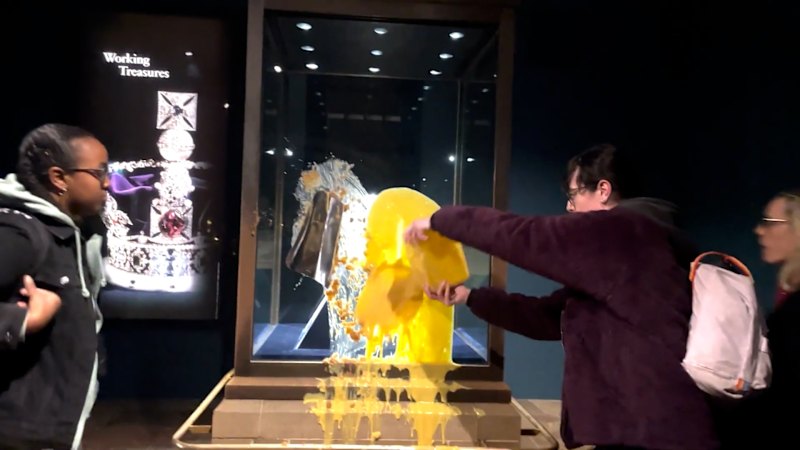
Custard, Crowns, and Contention: Activists Target British Monarchy in Protest
LONDON – In a brazen act of defiance, a group identifying as “Tax the Rich” targeted the British Crown Jewels at the Tower of London on Friday, smearing custard over the protective glass case housing the State Crown. The incident, while seemingly whimsical in its execution, underscores a growing wave of discontent with wealth inequality and the perceived opulence of the monarchy as economic pressures mount globally.
The protest, which occurred on December 7, 2025, saw several activists approach the display and quickly coat the glass with the dairy product before being apprehended by Tower of London security. While the Crown Jewels themselves were unharmed, the incident has sparked a national debate about the role of protest in a democratic society and the symbolism of the monarchy in a time of austerity. Footage of the incident quickly circulated on social media, drawing both condemnation and support.
A Sticky Symbol of Discontent
The choice of custard as a projectile is deliberate, according to a statement released by Tax the Rich. The group framed the act as a symbolic gesture, representing the “sweetness” enjoyed by the wealthy elite while ordinary citizens struggle with the rising cost of living. “The Crown Jewels represent centuries of accumulated wealth built on exploitation,” the statement read. “While families are forced to choose between heating and eating, the monarchy continues to flaunt its privilege.”
This isn’t an isolated incident. Protests targeting symbols of wealth and power have been on the rise across Europe and North America. From demonstrations outside the homes of billionaires to disruptions at luxury events, activists are increasingly employing direct action tactics to draw attention to economic disparities. The UK, in particular, has seen a surge in protests linked to the cost-of-living crisis, fueled by soaring energy prices and inflation. According to the Office for National Statistics, the UK’s inflation rate remains stubbornly high, impacting household budgets across the country.
The Monarchy Under Scrutiny
The British monarchy has long been a subject of debate, with critics questioning its relevance and cost in the 21st century. While the monarchy generates significant tourism revenue – estimated at £2.7 billion annually according to the Royal Collection Trust – the Sovereign Grant, funded by taxpayers, remains a point of contention. The current grant stands at £86.3 million for 2023-2024.
The incident at the Tower of London comes at a sensitive time for the royal family. King Charles III, who ascended to the throne in 2022, has pledged to modernize the monarchy and demonstrate greater public service. However, public opinion polls suggest that support for the monarchy is waning, particularly among younger generations. A recent Statista poll indicates that only 36% of 18-24 year olds believe the monarchy is “very important” for Britain.
Geopolitical Echoes: Wealth Inequality as a Global Flashpoint
The protest’s resonance extends beyond the UK’s borders. Globally, wealth inequality is reaching alarming levels. A report by Oxfam revealed that the richest 1% owns 59.4% of all global wealth, while the bottom 69% owns just 3.6%. This extreme concentration of wealth fuels social unrest and political instability, creating a fertile ground for populist movements and radical ideologies.
The situation is particularly acute in Europe, where many countries are grappling with economic stagnation and rising social tensions. France, Spain, and Italy have all witnessed large-scale protests in recent years, often triggered by austerity measures and perceived government inaction on wealth inequality. The rise of far-right political parties in several European countries is also linked to these underlying economic anxieties.
Beyond Custard: The Future of Protest
The incident at the Tower of London raises important questions about the future of protest. As traditional forms of political engagement become increasingly ineffective, activists are turning to more disruptive tactics to make their voices heard. While such actions often attract criticism, they also serve to highlight underlying social and economic issues that might otherwise be ignored.
The response from authorities will be crucial. A heavy-handed crackdown on protesters could further fuel resentment and radicalize the movement. A more nuanced approach, focused on addressing the root causes of discontent, may be more effective in the long run. The challenge for governments across the globe is to find a balance between protecting public order and respecting the right to peaceful protest. The smeared glass case at the Tower of London serves as a stark reminder that the debate over wealth, power, and privilege is far from over.
The Metropolitan Police have confirmed that several individuals were arrested and are being held for questioning. Investigations are ongoing.