Russia Drops Public Financial Disclosure for Officials | Poseidon System
Russia Tightens Grip on Official Finances, Raising Transparency Concerns
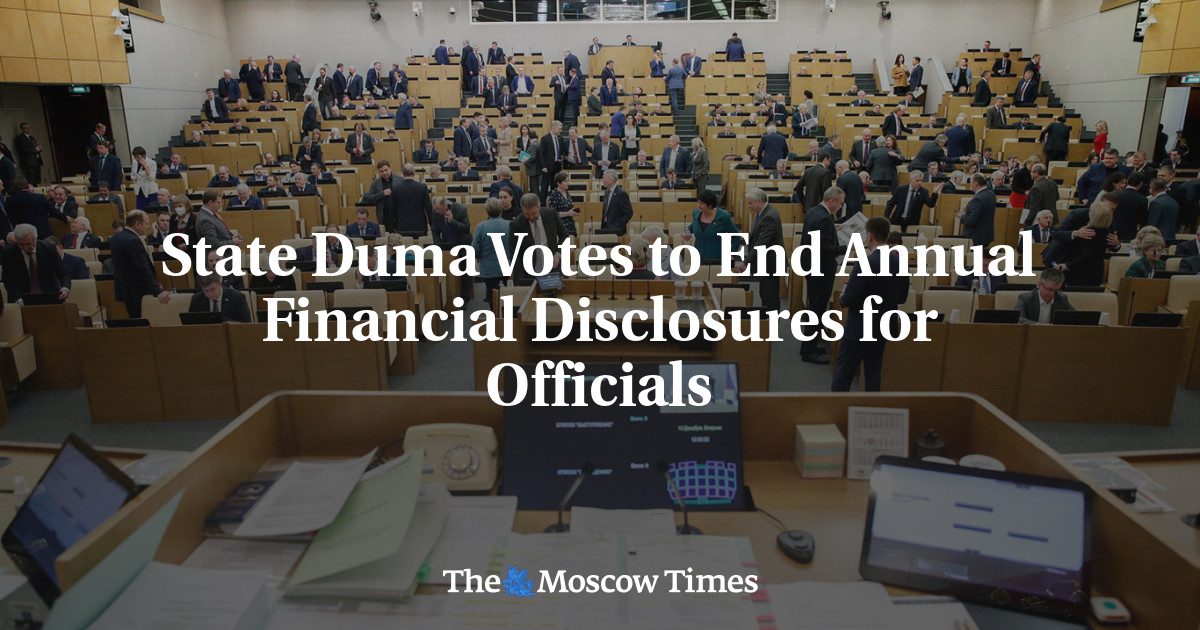
Moscow – In a move framed as modernization, but viewed by critics as a further erosion of accountability, Russia’s State Duma passed legislation on Thursday eliminating the requirement for most government officials to publicly declare their income and assets annually. The shift replaces public filings with a closed-system monitoring program called Poseidon, raising concerns about transparency and potentially shielding officials from scrutiny amid the ongoing conflict in Ukraine and increasing Western sanctions.
The legislation, swiftly approved just ten days after its introduction, will see financial oversight conducted through Poseidon, a real-time tracking system integrated with databases from the Federal Tax Service and financial watchdog Rosfinmonitoring. While officials will still be required to submit declarations when starting new positions, transferring agencies, or making significant purchases exceeding their family income, the public will no longer have access to this information.
A Shift in Oversight, or a Shield for Corruption?
Vasily Piskaryov, a lawmaker from the ruling United Russia party, defended the changes as a move away from an “outdated system,” claiming it would “facilitate prompt responses to corruption-related offenses.” However, the timing and nature of the legislation have fueled skepticism. The move comes less than a year after President Vladimir Putin suspended the mandatory publication of officials’ financial declarations in December 2022, citing wartime conditions. Shortly after that suspension, previously available disclosures began disappearing from official websites.
This latest legislation builds on that trend, effectively reversing a key component of Russia’s anti-corruption framework established in 2008. Before the changes, Russian law mandated that civil servants publicly disclose their income and assets, as well as those of their immediate family members. The stated goal was to promote transparency and deter illicit enrichment. Now, access to this information will be restricted to a select group of government bodies, including the Presidential Administration and the Federal Protective Service.
Echoes of a Broader Trend: Diminishing Freedoms
The move to curtail financial transparency is part of a broader pattern of restrictions on freedoms and increased state control within Russia, particularly since the full-scale invasion of Ukraine in February 2022. Independent media outlets have been shuttered, dissent has been suppressed, and laws have been passed limiting public criticism of the government and the military. This tightening of control extends to financial matters, raising concerns that it will become more difficult to detect and prosecute corruption.
The implications extend beyond Russia’s borders. According to a 2023 Corruption Perception Index by Transparency International, Russia ranks 141st out of 180 countries, indicating a high level of perceived public sector corruption. This perception impacts foreign investment and international relations. Furthermore, the ability of Western governments to enforce sanctions against Russian officials and oligarchs is hampered by a lack of transparency regarding their assets.
Poseidon: A Black Box of Financial Data?
The Poseidon system, touted by lawmakers as a modern solution, remains largely shrouded in mystery. Details about its functionality, security protocols, and oversight mechanisms are scarce. Critics fear that the closed nature of the system will make it vulnerable to manipulation and abuse, effectively creating a “black box” where corruption can flourish undetected. The limited access granted to authorized government bodies raises questions about accountability and the potential for conflicts of interest.
“The idea of a centralized system tracking assets sounds good in theory, but the devil is in the details,” says Dr. Elena Suetova, a political analyst specializing in Russian governance at the University of Oxford. “Without independent oversight and public access to information, such a system can easily be used to protect those in power rather than hold them accountable.”
Geopolitical Implications and the Cost of Opacity
The decision to limit financial transparency comes at a critical juncture in Russia’s relationship with the West. Sanctions imposed in response to the war in Ukraine have targeted Russian officials and oligarchs, aiming to pressure the Kremlin to de-escalate the conflict. However, the lack of transparency surrounding the financial holdings of these individuals makes it more difficult to identify and seize assets hidden abroad.
Globally, illicit financial flows cost an estimated USD 1.6 trillion to USD 2.2 trillion annually, according to the United Nations Office on Drugs and Crime (UNODC). Russia’s move to reduce transparency could exacerbate this problem, creating opportunities for money laundering and other illicit activities. The changes are set to take effect on January 1st, pending approval by the upper-house Federation Council and President Putin’s signature, solidifying a new era of financial opacity within the Russian government.
The long-term consequences of this legislation remain to be seen, but it undoubtedly represents a setback for transparency and accountability in Russia, and a potential obstacle to international efforts to combat corruption and enforce sanctions.